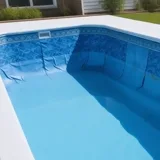
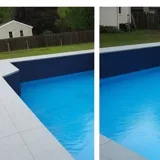
Fading and chalking are cosmetic until the vinyl starts losing its plasticiser, at which point the liner becomes brittle and leaks. Staining is a different problem with a different cause, and it is often a water chemistry signal rather than a liner defect.
Fading and chalking
Ultraviolet light and unbalanced water both attack vinyl. Low pH and high chlorine accelerate it, and a liner that has chalked will feel rough and may shed a powdery film. A faded liner that still flexes can live for years; a liner that has gone chalky and stiff is at the end of its service life and will crack before it tears.
Staining: rust, metals and scale
Brown or orange staining usually points at iron in the water or at corrosion behind the liner. Black or grey staining is often metal or organic. White, crusty deposits are scale from hard water. Knowing which of those you have decides whether the answer is water treatment or wall repair.
If the staining follows a line along the wall or concentrates near the skimmer, suspect the wall behind the liner and not the water. That is a shell inspection, not a chemistry problem.
What fixing it costs
| Issue | Typical approach | Published cost |
|---|---|---|
| Water staining (metals, scale) | Water treatment and balancing | Startup chemicals $80 - $200 |
| Localised staining with sound liner | Cleaning, spot treatment | Spot repairs $150 - $600 |
| Corrosion behind the liner | Wall treatment or panel replacement | Panel work quoted separately; structural work needs a Mecklenburg County permit |
| Chalky, brittle liner | Replacement | $700 - $2,500 above-ground; $2,100 - $5,500 typical inground |
How to stop the next one
Keep pH and chlorine in range, avoid shocking a vinyl pool harder than needed, and treat metals before they plate onto the liner. If the pool sits under trees or near a rusting fence, expect organic and iron staining and treat it early rather than scrubbing the liner, which dulls the print.
Frequently asked questions
Is a faded liner a problem?
Cosmetically, yes; structurally, only once it has gone chalky or stiff. A faded liner that is still flexible can keep working, especially if the print has not worn through.
What causes brown stains on a pool liner?
Usually iron, either in the fill water or from corrosion behind the liner. If the staining lines up with the wall framing or the skimmer, ask for a shell inspection rather than more water treatment.
Can a stained liner be cleaned?
Sometimes, with the right treatment for the metal or scale involved. Abrasive scrubbing dulls the print and shortens the liner's life.